Welcome to Tropical band

To most people the phrase "tropical bands" bring a pretty clear picture to mind - a bunch of shirtless guys playing calypso music. But to experienced shortwave DXers those two little words express the most challenging and enjoyable part of the radio hobby. The phrase kindles memories of a DXer's best catches and favorite QSLs, of exotic stations, music and of early morning listening sessions. (Don Moore)
I like the "Tropical band" name for new 60m allocation. (OK1RP)

Effective from 1st Jan 2017 please paper QSL via OM-bureau only.


Monday, March 6, 2017

VR - Hong Kong on 60m band


Hello,

Hong Kong is now on 5 MHz...
The local telecommunication authority in Hong Kong, OFCA has now allocated 5351.5-5366.5kHz to the amateur radio service on a secondary basis.

The maximum power permitted is 15 Watt EIRP.
More details can be found here:
http://ofca.gov.hk/filemanager/ofca/common/Industry/broadcasting/hk_freq_table_en.pdf
(Many thanks to Johnny, VR2XMC)


Hong Kong is an autonomous territory, and former British colony, in southeastern China. Its vibrant, densely populated urban center is a major port and global financial hub with a skyscraper-studded skyline.


Central (the business district) features architectural landmarks like I.M. Pei’s Bank of China Tower. Hong Kong is also a major shopping destination, famed for bespoke tailors and Temple Street Night Market.


Hong Kong is located on China's south coast, 60 km (37 mi) east of Macau on the opposite side of the Pearl River Delta. It is surrounded by the South China Sea on the east, south, and west, and borders the Guangdong city of Shenzhen to the north over the Sham Chun River. The territory's 2,755 km2 (1,064 sq mi) area consists of Hong Kong Island, the Kowloon Peninsula, the New Territories, and over 200 offshore islands, of which the largest is Lantau Island. Of the total area, 1,106 km2 (427 sq mi) is land and 1,649 km2 (637 sq mi) is water. Hong Kong claims territorial waters to a distance of 3 nautical miles (5.6 km). Its land area makes Hong Kong the 167th largest inhabited territory in the world. Less than 25% of Hong Kong's land area is built-up, while the majority is grassland, woodland, shrubland, and agricultural land.


In 2014, Hong Kong was the eleventh most popular destination for international tourists among countries and territories worldwide, with a total of 27.8 million visitors contributing a total of US$38,376 million in international tourism receipts. Hong Kong is also the most popular city for tourists, nearly two times of its nearest competitor Macau.


73 - Petr, OK1RP
.../-.-


CX - Uruguay gets 60m band


Hello,

Uruguay gets 60m as follows:
5351.5 – 5366.5  kHz (Secondary)
General and Superior licences


5351.5 – 5354.0  CW & Digimodes
5354.0 – 5366.0  All Modes
5366.0 – 5366.5  CW & Digimodes
 
Max. power -  General : 15 W EIRP   Superior: 25 W EIRP
 
More details can be found in Spanish here:

(Many thanks to Paul, G4MWO for info)

Uruguay is a South American country known for its verdant interior and beach-lined coast.


The capital, Montevideo, revolves around Plaza Independencia, once home to a Spanish citadel. It leads to Ciudad Vieja (Old City), with art deco buildings, colonial homes and Mercado del Puerto, an old port market with many steakhouses. La Rambla, a waterfront promenade, passes fish stalls, piers and parks.


Population: 3.407 million (2013) World Bank

Currency: Uruguayan peso


The tourism industry in Uruguay is a stable component of their economy. Whether tourism contributes to the overall productivity of the economy, or provides stability by way of jobs, it is a force they have chosen to emphasize. As of 2008, 10% of the nation's jobs were based in the tourism industry. In 2007, Uruguay brought in nearly 1.8 million tourists. The bulk of the tourists in Uruguay settle themselves around the rich culture of the country as well as the scenic natural attractions. Cultural experiences in Uruguay range from interacting with the indigenous people to colonial history, as found in Colonia del Sacrementa. Montevideo, the country's capital, houses the most diverse selection of cultural activities. Historical monuments such as Tores Garcia Museum as well as Estadio sentenario, which housed the first world cup in history, are only a couple samples of the culture depth that tourists commonly seek. However simply walking the streets allows one to experience the colorful blend of culture the city has to offer.


One of the main natural attractions in Uruguay is Punta del Este. Punta del Este is a prominent tourist destination on a small peninsula off the southeast shore of Uruguay. Its beaches are divided into Mansa, or meek, (river side) and Brava, or brave, (ocean side). These beaches offer versatility to the tourist experience, the Mansa being more ideal for sunbathing, snorkeling, & other low-key recreational opportunities, and the Brava being more ideal for adventurous water sport enthusiasts. Punta del Este is virtually connected to the city of Maldonado and eastward spread widely, encompassing La Barra and José Ignacio. It has 122 hotels, 80 restaurants, an international airport and a yacht port that can accommodate 500 boats.
For more in-depth coverage of Uruguay's vast tourism opportunities, see this list by Welcome Uruguay


73 - Petr, OK1RP
.../-.- 

Wednesday, March 1, 2017

V2 - Antigua Island on 60m band by DL7AFS

Hello,

V21ZG Antigua Island : DL7AFS and DJ7ZG will be active again from Antigua Island (IOTA NA-100) 28 February - 26 March 2017 as V21ZG.

They will operate on 80-6 m (including 60m band - 5357kHz) mainly SSB, RTTY, PSK, SSTV.
 

QSL via DL7AFS direct, ClubLog OQRS, LOTW.
Ads for direct QSL: Baerbel Linge, Eichwaldstr. 86, 34123 Kassel, Germany.


Do not expect their operation on CW unfortunately...


73 - Petr, OK1RP
.../-.-

5U - Niger on 60m by Toni, EA5RM


Hello,

As I informed some time ago... Toni, EA5RM as team leader of 5U5R DX-pedition will try to be in March 8-21 on 5360 CW and SSB. He will receive us on 5371.5 or 5403.5 SSB and CW frequencies accordingly.

QSL via EA5RM
Antonio Gonzalez
P.O.Box 930
E-03200 Elche
SPAIN

More information and updates can be found here:
http://www.dxfriends.com/5u5r/index.php


73 - Petr, OK1RP
.../-.-

PJ4 - Bonaire on 60m by David, NA2AA

Hello,

David, NA2AA inform dxnews.com, that K2NG, NA2AA, K3SW along with PJ4LS and PJ4DX will be active from Bonaire Island in the ARRL DX SSB Contest 4 - 5 March 2017 as PJ4G.

They will be in M/2 Category.
The U.S. operators will be signing PJ4/Homecall before and after the contest.
Digital skeds for ATNO with PJ4 can be made with NA2AA via his QRZ email.

QSL for PJ4G via WA2NHA, LOTW.
QSL for operators is via direct and LoTW.


David PJ4/NA2AA will put on this new one when he activates the island March 2, and 5th and 6th. He should be on after 0100z on 5357. He will spot on DX Watch cluster. David understands this is the JT65 channel where there is a lot of activity, but it’s the only channel the authorities have authorized. David may also be on just before his sunrise.


73 - Petr, OK1RP
.../-.-

HAARP UAF 2.72MHz carrier, second Harmonic at 5.44MHz - Auroral doppler /fade by Laurence, KL7L

Hello,

Published on Feb 26, 2017 by Laurence, KL7L

"Looking at HAARPs 23rd Feb 2017 second harmonic signal and visualizing the fade pattern and doppler/scintillation pattern. Was the Auroral style doppler naturally/solar interaction,, created by HAARPs 2.72MHz carrier or a mix? Audio on right hand channel of 2.72MHz is suppressed for easier listening."

https://youtu.be/Xpj8JopANm4

Is there anybody else who noticed the same on the 60m band during the HAARP tests?


73 - Petr, OK1RP
.../-.-


Friday, February 17, 2017

HAARP - QRM nightmare returns...?

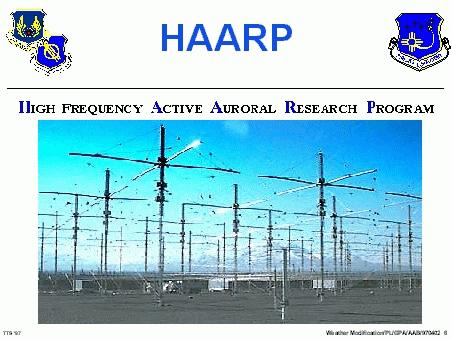
The High Frequency Active Auroral Research Program (HAARP) in Gakona, Alaska, will soon undertake its first scientific research campaigns since the facility was taken over by the University of Alaska Fairbanks (UAF) Geophysical Institute 18 months ago. Among the investigators is UAF Researcher Chris Fallen, KL3WX, who will be working under a National Science Foundation grant, “RAPID: Spatiotemporal Evolution of Radio-Induced Aurora.” Fallen says the HAARP transmissions will take place within the facility’s transmitter tuning range of 2.7 to 10 MHz and should be audible outside of Alaska and may even produce visible effects within the state.

Fallen's experiments will be carried out February 19-22.
“This time my experiments will largely focus on artificial radio-induced airglow that potentially can be photographed from nearly anywhere in Alaska — weather permitting,” Fallen told ARRL. “I plan to start and stop each experiment block with an audio Luxembourg-style broadcast — transmitting two amplitude-modulated carrier waves at different frequencies separated by about 1 MHz, with the resulting skywave signal being a mix of both frequencies.”

Fallen said that he has prior success reproducing the “Luxembourg effect” using two DTMF tones. “But this time, I have a short simple musical composition recorded by a local musician,” he said. “It was composed specifically to take advantage of the Luxembourg effect.”

According to UAF, Fallen, an assistant research professor in space physics, will create an “artificial aurora” that can be photographed with a sensitive camera within Alaska. The phenomenon has been created in the past above HAARP during certain types of transmissions.


Just which HF frequencies Fallen will use won’t be determined until shortly before he begins his research. “The specific frequency chosen during a particular experiment depends on the experiment’s objectives, FCC regulations, and ionospheric conditions at the time,” Fallen explained. He will use ionosonde data to guide frequency selection.

In an explanatory blog, Fallen explains that HAARP scientists use the ionosonde to estimate two important parameters: (1) the amount of low-level ionosphere D-region HF radio absorption that frequently occurs due to natural, but not well understood, processes that prevent HAARP radio wave energy from reaching the higher ionosphere E and F regions; and, (2) the ionosphere vertical “critical frequency” [sometimes referred to as foF2], above which any radio transmissions pass through the ionosphere into space rather than being reflected or absorbed.”


Fallen said experiment times and frequencies for his airglow and Luxembourg experiments will be updated on his blog and on his Twitter account linked in the blog. He encourages radio amateurs and SWLs to record the events they hear and post reports to social media or e-mail him.

Built and operated by the US Air Force until August 2015, HAARP includes a 40-acre grid of antennas and a very high-power array of HF transmitters to conduct ionospheric research. Scientists later this month will use HAARP to conduct other experiments that will include a study of atmospheric effects on satellite-to-ground communications and over-the-horizon radar experiments.

About HF radio transmissions from HAARP

HAARP is essentially a large powerful radio transmitter, similar in some respects to commercial large radio stations and radar installations. Unlike a commercial radio station, where radio (electromagnetic) wave energy is usually radiated in all directions to reach the largest possible audience, most of the HAARP radio wave energy is radiated in a relatively narrow beam, steerable by approximately 30 degrees off the vertical direction. Another unique feature of HAARP is that it can be tuned to transmit at any legally allowed radio frequency between approximately 2.7 and 10 MHz, or even two frequencies simultaneously. Radio waves in this HF band can often propagate large distances, sometimes completely around the Earth, by successively reflecting off the ionosphere, the Earth surface, and the oceans. (Radio waves with higher frequencies usually do not reflect from the ionosphere and simply pass through to deep space.)


Example audio recordings of HAARP radio broadcasts

There are several examples of HAARP broadcasts available online. Some of these examples were recorded intentionally due to prior announcement of HAARP activities, and some were recorded by happenstance by hobbyists who monitor the radio spectrum. If you know of other online examples of recorded HAARP transmissions please share them with me through the contact link at the top of this page so I can add them to the list below.

Moon bounce (HAARP was "aimed" at the moon to duplicate a favorite ham radio communication mode)

Luxembourg effect (HAARP transmitted two audio tracks at different radio frequencies simultaneously to duplicate the Luxembourg effect.

See the hissingchorusofdawn Soundcloud links from the linked NPR All Things Considered article.)

HAARP Oddities at 2.75 MHz Recording from the Mojave Desert of a HAARP transmission with a ULF amplitude modulation

HAARP Oddities at 5.8 MHz Recording of a HAARP transmission with an linear ramp amplitude modulation


73 - Petr, OK1RP
.../-.-